The Professional

Roddick d. Gulbis, 6/3 7/6

After some weeks devoid of almost any discernible suspense, the eight qualifiers for the World Tour Finals have been decided. In the end it all came in a flurry, and panned out exactly as expected. I’d like to boast that I predicted it, but I assume everyone did. Roddick, Berdych and Ferrer are in. Verdasco and Melzer aren’t. As with Soderling a few weeks back, Berdych and Ferrer qualified for London on a day when they lost. I’m well aware that qualification for London reflects your performance throughout the whole year, but it still seems fitting. Of the three, only Roddick – poor, pedestrian Roddick – actually posted a win today.
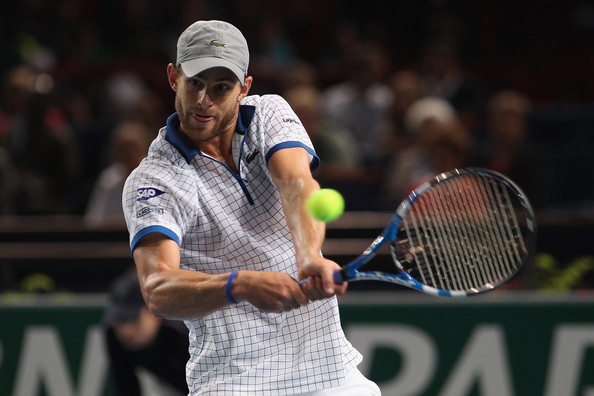
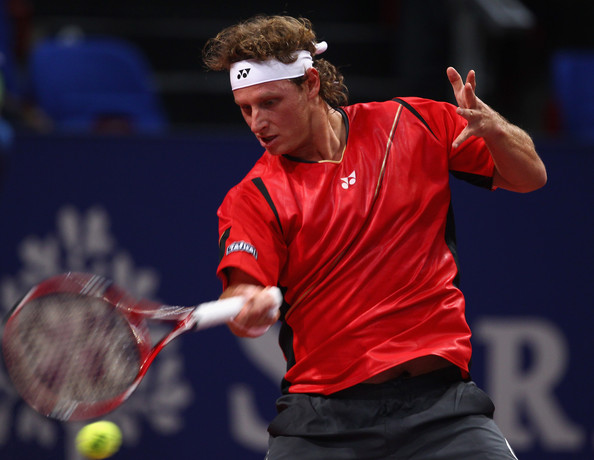
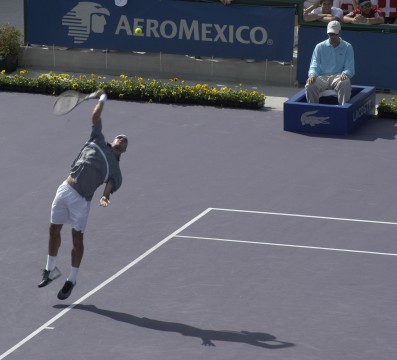
As it happened, Roddick proved far too professional for an erratic Ernests Gulbis. ‘Professional’, used in this context, may seem kind of synonymous with ‘pusher’, but I think that’s unfair to Roddick. He has shown enough times in the last few weeks that he’s perfectly capable of stepping it up when the situation calls for it (notwithstanding some limp-noodle flailing against Federer last week). The situation against Gulbis certainly didn’t call for it. Roddick is ‘professional’, then, not because he pushed, but because he read the matchup perfectly, and stuck to his plan, even when the big Latvian looked like taking the match away in the breaker. I think it’s time to acknowledge that there’s an almost heroic quality to Roddick’s restraint. It’s not like he can’t hit a big forehand when he wants to, but he’s learnt from long experience and a line of illustrious coaches that the percentage play against streaky opponents is to keep it steady, and keep it in. (As I write that, I picture Gandalf’s urgent whisper: “Keep it steady. Keep it in!”) I used to marvel at the persistence of, say, Patrick Rafter charging the net against Andre Agassi, and wonder how he could keep it up after enduring so many devastating passes. A lesser man would surely crumble, and resort to Plans B through Q, however ludicrous they might be. But Rafter knew that he was going to get passed, and he knew where the percentages lay. Similarly, Roddick knows that a shotmaker is going to run cold and hot, and that the hot streaks just have to be weathered. And let’s not forget that he has the biggest serve the world has ever seen, and bombs it in at 81%. That’s a percentage play, right there.
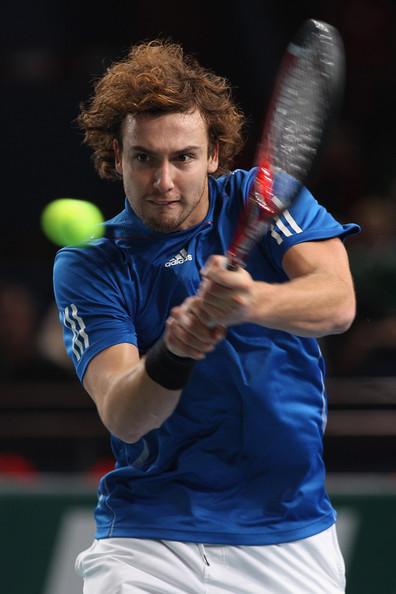
There are some that now mention Gulbis alongside Nalbandian or Gasquet (or even, gasp, Safin), but that’s a bit premature. It takes years of not delivering on early promise to earn that comparison. Was he featured on the cover of any national publications at age nine, and loudly proclaimed the future of Latvian tennis? Did he once hold a 5-0 head-to-head against Roger Federer (or the current equivalent, um, Roger Federer)? From what I’ve seen of Ernests Gulbis, he is actually playing as well as he can. Tennis is not just about hitting the ball well. It’s also about mental strength, and hitting the ball in. The problem is that we view talented ball strikers as somehow defective if they can’t get their heads together. Our expectations for them are sky-high. Conversely, a tactically-aware, mentally-strong guy with limited firepower is applauded for just making the top 50. It’s an issue I’m keen to expand on another time, but for now I’ll say it comes down to how we value talent over mere hard work, regardless of the egalitarian promise of the latter, and the inherent elitism of the former.

Melzer d. Ferrer, 7/6 2/6 6/3
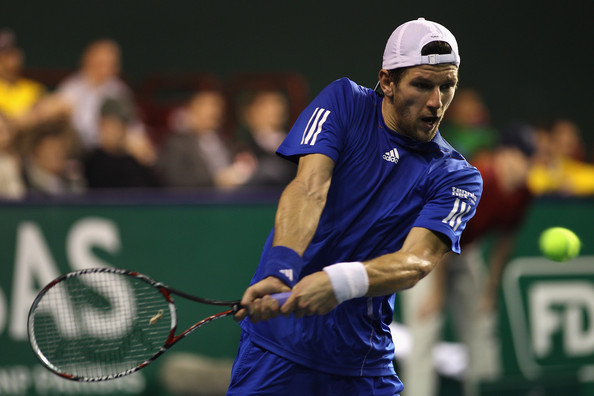
Incidentally, Roddick’s win means Jurgen Melzer can’t qualify for London, even if he wins Paris. He probably won’t anyway, though he did post a fine win today over David Ferrer. He’s through to the quarterfinals, and earns the privilege of facing his good friend Federer for the third time this year, after having not crossed paths in match play for the first decade of their pro careers.

Davydenko d. Berdych, 4/6 7/6 6/0

Tomas Berdych went down to Nikolay Davydenko, 4/6 7/6 6/0, a scoreline that ably illustrates how the match went. Don’t you love it when that happens? It may be premature to lump Gulbis with Gasquet or Nalbandian, but Berdych feels about right: a big guy with the capacity to beat anyone on a given day, and lose to everyone on every other day. Several times in the second set he was within two points of the match, which is exactly half as many points as he won in the third. Look out for him in London, where his role will be to stuff up any easy predictions.

Monfils d. Verdasco, 6/7 7/6 7/5

Fernando Verdasco fell to Gael Monfils in a tight affair that was pretty entertaining despite the efforts of both players. Monfils remains on track to claim the title, and thereby punish me for momentarily hoping he would.

Llodra d. Djokovic, 7/6 6/2

The other interesting result was Michael Llodra’s upset of defending champion Novak Djokovic, which has no ramifications for London, but could affect the Davis Cup final. Still, one result on a slick hometown hardcourt in Paris might not inspire Guy Forget to pick Llodra for singles duty, but then, with Tsonga out, he may have no choice. Simon? Gasquet?
1 Comment

Filed under ATP Tour

Bercy Notes, Round One

Clement d. Lopez, 6/7 7/6 6/3

The more I contemplate depressing tennis careers – and I’m compiling a post on it, though it’s really crying out for a gritty miniseries – the more names I feel compelled to add. The latest is Arnaud Clement. He was runner-up at the 2001 Australian Open. Nearly ten years later, 32 years old, he’s losing in the first round of Challengers. Coming into Paris he’s won just one match at tour level since the US Open. Now he’s won another one, over Feliciano Lopez, who has also fallen on hard times.

Based on their form, the match did not surprise. Nor did it delight. According to the headline on the ATP website, they produced 52 aces between them. Clement is 5’8”, and serves like it, yet he managed 22 aces and did not face a break point all night. Lopez was not effective on return.

Gasquet d. Mahut, 7/5 4/6 7/6

Nicolas Mahut is of course renowned for not winning the most absurd match in history, the one between John Isner and that other guy. Mahut is that other guy. Richard Gasquet, as I suggested last week, is famous for making David Nalbandian look like an overachiever. He posted an unconvincing win today – a lucky win – though that’s an improvement over the gorgeous losses he often produces. It was another heart-breaking first round loss for Mahut, but that’s kind of become his thing. He’ll now probably have to qualify for the Australian Open come January. For his sins, Gasquet gets to play Roger Federer in the second round.

Leave a Comment

Filed under ATP Tour

Merely the Best

Federer d. Djokovic, 6/4 3/6 6/1

There are many ways to analyse a tennis match, most of them wrong.

One of the best, clear in hindsight but typically missed as it occurs, is the Change of Momentum. A desperate winner might rock an opponent back on their heels, generating a flurry of errors. A stray double-fault can blossom into a serious affliction of the yips. With few exceptions, these trends only become clear once they’re trending, or even ending, but never when they start. The one exception is the 120-second break at the end of each set. Few other moments in a tennis match stop momentum as dead.

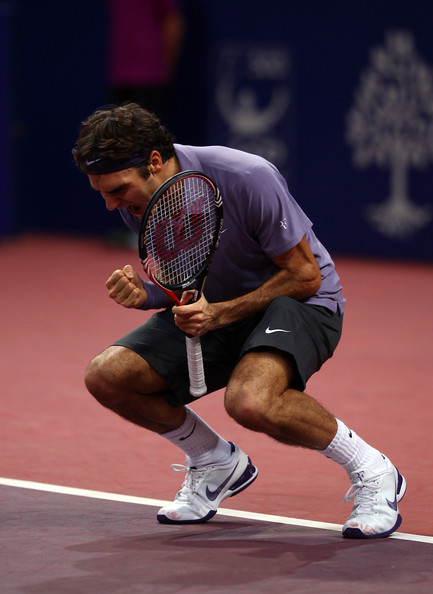
It was certainly the most curious thing about Federer and Djokovic’s second to last meeting, the highly-dramatic but otherwise somewhat-overrated semifinal at the US Open, where Federer’s form lurched radically from set to set. It was clear again last night. The two played a tight first set, which the slightly stronger player (Federer) won. Then, as he had the day before against Roddick, the Swiss came out flat in the second set, and was immediately broken. He ended up losing it 6/3, though it wasn’t as close as that. Then came another sit-down, and this time it was Djokovic’s turn to ratchet down the intensity. He went from capturing the second set comfortably, to hardly being able to find the court. Federer lifted, and that was that: 6/1. Game, set, title. Three discreet sets, each apparently cropped from different matches between different men. I have no clear explanation.

Sometimes a subtle alteration can yield immediate and clear results, as when Rafael Nadal rotated his service grip by a few degrees in the week before the US Open, and then served his way to a career Grand Slam. Sometimes the changes are more subtle, discernible only to the most committed and seasoned onlookers. Sometimes the effects are so subtle that there appears to be no impact whatsoever. I like to think I’m a pretty committed and seasoned onlooker, but I confess I searched in vain for any of that patented new aggression Paul Annacone has apparently injected into Roger Federer’s game. He rushed the net maybe six times, and got passed or fluffed the volley almost without fail (or with fail, as the case may be). I think he went big on one second serve, and missed it. Perhaps he came over more backhand returns? Certainly more than against Roddick in the semifinal, but regardless of the universally cherished belief to the contrary, he never devolved into a chip-return-merchant a la Sampras.

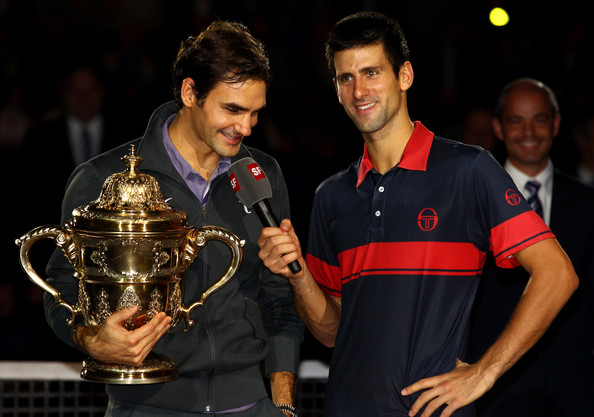
For all that, there was no shortage of the old Federer aggression, and he did actually beat an in-form Djokovic in the Basel final, romping away 6/1 in the final set, and avenging his loss at the same stage 12 months ago. With or without Annacone, Federer maintains a pretty attacking disposition, and his relentless game clearly poses severe problems for Djokovic. As in Shanghai (albeit not so dramatically), Djokovic came into the match in excellent touch, and left looking frankly unravelled. In all the talk of decline and what-not, Federer remains one of the finest players to ever pick up a racquet. Fans, commentators, and sundry hangers-on may forget that, but Novak Djokovic clearly hasn’t.

Federer has now recaptured the ATP event that means the most to him (possibly excluding the Masters Cup / Tour Final). Incredibly, Basel is the ninth tournament that Federer has won at least four times. As stats go, it’s pretty obscure, but also pretty impressive. It was his fourth title for the year (his second in a row), and his 65th overall, moving him clear of Sampras into outright fourth on the all-time list. Lest he feel left out, here’s an obscure-cum-interesting stat for Djokovic: since his first round win in the US Open, the Serb has not dropped a set to anyone not named Federer or Nadal. I wonder just how many weird records there are floating around the men’s tour, all qualified by the line ‘*apart from Federer and Nadal’?

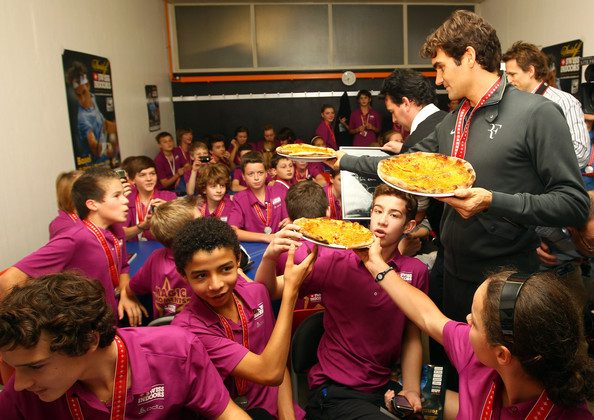
My favourite moment came in the third set: Djokovic is serving at 1/4. Federer has blown a couple of points for a double-break, and gets a look at a third. As he goes to the ballboy for a towel, he asks him something, smiling. The ballboy, petrified with reverence, begins nodding wide-eyed. Federer hands him back the towel, and walks over to take up his return stance with a grin. I wonder what he said, but I suspect it was something along the lines of, “Be nice if I could take one of these, wouldn’t it?”. Or maybe he was asking the kid to choose pizza toppings for after the match. Either way, I’m reminded that Federer was as a ballboy at this very tournament, and of the awe he must have felt for the pros he was on court with. It was nice to see something like this paid forward. As it happened, he did win the very next break point, and then served out his home championship at love.

Leave a Comment

Filed under ATP Tour

We Sell Sizzle

Basel, Quarterfinals

Roddick d. Nalbandian, 6/4 6/4

Unremarkably, when David Nalbandian is winning he looks unbeatable. Curiously, he looks equally infallible when he loses, which is to say that most of his losses feel like upsets, even though there are plenty of them. There are other players that are as natural as Nalbandian off the ground – a certain Swiss chap springs to mind – but I don’t think there are any better. For sheer timing, variety and the capacity to change direction at will, his backhand is the best I’ve ever seen. It is one of the few backhands that Rafael Nadal fears, since its potency can so effectively blunt the Spaniard’s greatest strength. But Nalbandian’s forehand is also brilliant, and the timing is so good that describing it involves delving into strange metaphorical territory: I have watched Nalbandian strike hundreds of forehands – he’s a fearsome sight on a practice court – but with the naked eye I’ve always found it hard to ascertain precisely when the point of contact occurs, as though it occurs within a cloud of possibility, like an electron. Where you think contact occurs never quite tallies with the sound of the ball meeting the strings. And like the backhand, he never looks like he’s taking a particularly big cut at the ball, yet the power is there, and the winners flow.

Nevertheless, he lost today, proving that all the technique in the world can’t save you if you’re mentally patchy against a seasoned professional like Andy Roddick. For his part, Roddick served beautifully, never facing a beak point all night, and for a change backed it up with an aggressive ground-game, which is essential against a returner of Nalbandian’s quality. Hustling and bustling, Roddick played like there was a spot in London on the line, as opposed to, say, Berdych and Verdasco, who played like a couple of disinterested bozos.

Troicki d. Gasquet, 6/4 6/2

Speaking of sublimely gifted ball strikers, Richard Gasquet may well finish up boasting no greater accolade than being the guy who made Nalbandian look like an over-achiever.

Since almost toppling compatriot Novak Djokovic at the US Open, Victor Troicki has been one of the real movers of the late-season, so far highlighted by claiming his first title in Moscow a few weeks back. He has now leap-frogged Tipsarevic to be the second ranked Serb, and has surely pushed himself into singles selection for the Davis Cup final. He’ll have a chance to get one back against the top-ranked Serb in tomorrow’s Basel semifinal.

In other news, Nadal has pulled out of the Paris Indoors next week, citing tendinitis in his serving shoulder. Will he manage to miss the Tour finals for the third time in the last six years?

Leave a Comment

Filed under ATP Tour

Slouching Towards London

Simon d. Verdasco, 6/1 6/3

Kamke d. Berdych, 6/4 6/1

Ah, London. The Great Wen. It’s so close, you can smell it. The luridly blue O2 Arena, hordes of hoarsely hollering Brits, photo-shoots featuring double-decker buses. The cash (oh, the cash!). The elite of men’s tennis. Tomas Berdych.

If you can’t win a Slam – and most chaps not named Rafael or Roger clearly can’t – then getting to the Tour finals in London is about as good as it gets. Five of the eight places have already been filled, by the Big Four and the Swede-most-likely Soderling. With a bare two weeks of the regular season remaining, there are now six guys desperately vying for those remaining three spots. Now is the time to bring your A-game, give 110%, and INSERT MOTIVATIONAL LINE HERE.

Still, even with it all to play for, it wasn’t particularly shocking when Fernando Verdasco and Tomas Berdych succumbed to vigorous man-handlings by Gilles Simon and Tobias Kamke respectively. Despite barely stringing together consecutive wins since August, Berdych remains almost certain to qualify for London. Verdasco has been even less impressive, and almost certainly won’t. Andy Roddick – poor, cursed Roddick – will probably get there, as will the redoubtable and versatile David Ferrer. Youzhny and Melzer, absent with ailing bodies this week, will most likely have to win Paris next week to get a look-in (they won’t).

Monaco d. Murray, 6/2 3/6 6/2

It’s hard to know what to make of this one, especially given how effortlessly Murray handled Monaco in Shanghai a few weeks back. If it happened in the O2, it’d clearly be due to The Pressure. But in the postmodern bone-cathedral thing in Valencia? No idea. The last time I said something like that, the chirpy Scot smashed his way to the Shanghai Masters title. Am I saying he’ll win Paris? No.

David Nalbandian will.

2 Comments

Filed under ATP Tour

Separated at Birth

Kukushkin d. Youzhny, 6/3 7/6

Melzer d. Haider-Maurer, 6/7 7/6 6/4

Monfils d. Ljubicic, 6/2 5/7 6/1

“Today I was again very solid I think in my game, but also emotionally. I am extremely happy about the title, about my concentration throughout the week and about the level of my game. I feel I have been working on many things on and off the court and the results are now showing. It was a fantastic event, I felt really comfortable over here from the first day. I really hope to be able to come back next year.” Stirring words, straight from the ATP Media Relations Song Book. When the time comes for ATP: The Opera to be unleashed, they’ll doubtless make a smashing aria. In the meantime, I defy anyone to guess which of today’s three title-winners uttered them.

Youzhny was upset in St Petersburg, Melzer was nearly upset in Vienna, and I was vaguely upset here in Melbourne at seeing Monfils overcome a tired-looking Ljubicic in Montpellier. Several weeks ago I essayed the seemingly quixotic suggestion that Gael Monfils might take Paris, or something to that effect. Well, he’s now hitting form, and I could well be in for a lesson in being careful what I wish for. From now on I’ll be ratcheting up the outrageousness of my outrageous suggestions, lest any actually come true. You see, I’ve stared into the abyss – of course, it stared back – and I realised I’d rather Monfils didn’t win Paris.

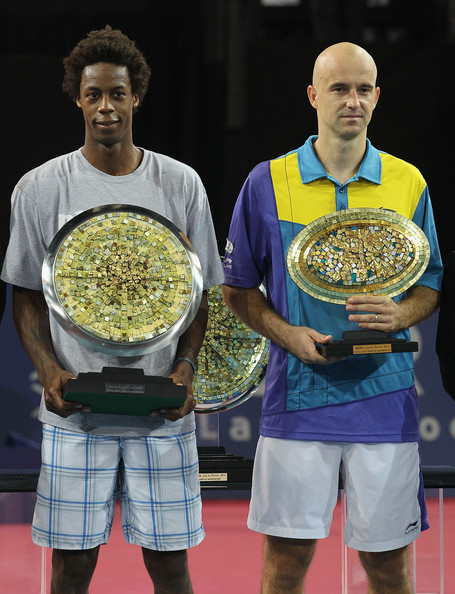
European indoor tournaments have long been renowned for their ridiculous trophies, and Montpellier, the newest event on the block, does not disappoint. What variety of luggage do players haul around in preparation for these tournaments? Ljubicic’s runner-up platter seems uncannily similar to Monfils’, which is unfortunate since the players are already so hard to tell apart.

Leave a Comment

Filed under ATP Tour

The Curious Case of Robin Soderling

Robin Soderling has now qualified for the ATP World Tour Finals – the unfortunately acronymed WTF – for the second year in a row. He is the world No.5, and his name is invariably in the mix when the big events are previewed. Some even installed him as the favourite at the US Open.

Yet for all that, I have to ask: Why? What has Robin Soderling really done to deserve consideration, let alone favouritism? Isn’t he really just the best of rest, leading a second tier that’s looking decidedly third-rate? Frankly it felt fitting that in the end Soderling qualified for the WTF due to poor performances from the other contenders, on the very day he folded meekly to Florian Mayer in Stockholm.

When Soderling defeated Rafael Nadal at Roland Garros in 2009 – to date the only man to do so – it sent a profound shock through men’s tennis. (When Rafael Nadal defeated Robin Soderling 1 and 0 at the Rome Masters a few weeks earlier, it didn’t.) It ended Nadal’s bid for a fifth consecutive French Open, and set in motion a chain of events that would see the Spaniard relinquish his No.1 ranking. When Soderling beat defending champion Federer in the quarterfinal of the 2010 French Open, it was similarly momentous: it ended Federer’s absurd run of 150,000 consecutive Grand Slam semifinals, and – when Nadal inevitably won the title later that week and reclaimed the top spot – it left the Swiss one agonising week short of Sampras’ record for most weeks at No.1. In both cases, Soderling played great, and totally deserved to win. But regardless of how well he played, the momentousness of each win had little to do with the Swede or his performance, and everything to do with the historical runs he ended.

Since those losses, both Nadal and Federer have each beaten Soderling twice, all on relatively important occasions. Nadal beat him in the Roland Garros final and Wimbledon quarterfinal, while Federer took him out in the US Open quarterfinal and thrashed him in the quarters of the Shanghai Masters. They have won those four matches for the combined loss of one set. You cannot reasonably call this a rivalry.

Since ascending to the near-heights of the men’s tour some 16 months ago Soderling has won exactly two titles: the very-scenic-but-not-terribly-important 250 event at Bastad, and the somewhat more prestigious 500 tournament in Rotterdam. Indeed, if we exclude his two runs to the French Open finals, his career results begin to look pretty sparse. He has never progressed to the semifinals of another Grand Slam, and he has never made it to the final of a Master Series event. And this is the world No.5.

Part of the problem – and it has been an issue for some years now – is that there are only a finite number of points to go around, and the guys at the top are so consistently dominant that they tend to hog most of them. Nadal and Federer both have the capacity to hoover up many of the big point-hauls, and Djokovic and Murray tend to grab whatever is left. Relatively little is is left for everyone else. If nothing else, Soderling is living proof that you can earn a very high ranking without winning anything of note, or even getting to any finals (Roland Garros excepted).

2005 was a striking example of this. Federer and Nadal between them captured 3 of the 4 Grand Slams, and 8 of the 9 Masters Series events. Federer also lost in the final of the Masters Cup. That’s a lot of ranking points shared between just two guys. Now, of the players who won the other events, Safin (Australian Open) finished at No.12, Nalbandian (TMC) at No.6, and Berdych (Paris Indoors) at No.25 . This left us in the vaguely ridiculous situation where most of the top 10 – including Hewitt, Agassi, Davydenko and Roddick – basically won nothing that mattered. The situation was much the same in 2006, only this time ‘Fedal’ took out all four Slams, 6 of the 9 Masters Series, and the TMC. If we think of ranking points as sunlight, and Federer and Nadal as big shady trees . . . well, you get the picture.

There is another issue at play here, namely, injuries to the premier players of the second tier: Davydenko, del Potro and Roddick. Before he was injured, del Potro was at No.4, and there was a widespread belief that he could really take it to Nadal and Federer. Davydenko finished 2009 in glorious form, capturing the Tour Finals and his third Masters Shield in Shanghai. (His good form continued into 2010, right up until exactly 3-1 in the second set of the Australian Open quarterfinals.) Roddick enjoyed a stellar few weeks in the US spring, but has since been underwhelming, and not helped by contracting glandular fever and seriously injuring his leg in Shanghai. If we were to chart tennis ability and results on a graph, these three helped produce a relatively smooth curve between the Big Four and the streaky headcases and inspired journeymen milling about between 10 and 20. Their injuries have left a vacuum, which is why we see Soderling, Berdych and co. rising up the rankings, despite not really being much better than they were a year ago, and certainly not by winning anything.

Now, if Soderling was to start winning titles, this is the time to do it. We’re endlessly reminded that the European indoors is his place to shine, where his stratospheric ball-toss is at less risk from passing comets, and his windmilling forehand is less affected by, well, wind. Four of his five titles have come in Europe, indoors.

Now don’t get me wrong, I actually like the guy. I want to see him do well. Imagine if he won at Bercy? Then we’d really be thinking WTF.

Leave a Comment

Filed under ATP Tour, Players

Great Matches You’ve Probably Never Heard Of #2

Tennis Masters Cup 2003 Round Robin

Federer d. Agassi 6-7, 6-3, 7-6

Roger Federer arrived Houston in November 2003 as a relatively modest world No.3, weary after a middling indoor season, and publicly irritated with the tournament itself.  He would leave as the best tennis player on Earth. Six years later he would be widely considered to be the greatest tennis player of all time. It is an audacious claim to say that this match is where it all really began, but it is not entirely without merit.

Federer’s first Wimbledon title had of course been a triumph, and his play in the final two rounds – with resounding victories over Andy Roddick and Mark Philippoussis – was magisterial. But we’d all known that he was capable of playing like that. The question for some time had been whether he was capable of sustaining it for two weeks at a major. Indeed, our admiration for the perfection of his play was somewhat tempered by a general sentiment of ‘Well it’s about time’. The consensus in the months since was that he had now lifted to a higher level, if not of ability then of consistency. However, he had failed to fire during the US hardcourt season, and had hardly posted astounding results during the European indoor events, with a single title in Vienna and fairly soft losses in Madrid and Paris. Again, this was not unexpected. He was a streaky, brilliant player. It was the kind of effort expected of a world No.3. By contrast, Roddick and Ferrero – the world Nos. 1 and 2 – had dominated the remainder of the season.

However, Roger Federer was about to go on a hot streak that would last for four years, without pause, posting the kind of numbers that had never been seen before in the sport. So what happened? Something changed in Federer, and it occurred between arriving in Houston, and playing the final a week later. The Federer Era commenced with this tournament.  It began with this match.

I might be my imagination, but it seems like you can actually see it happening as the match progresses. Just watch Federer’s court position. In the first set he is frequently on a string metres behind the baseline, exactly where Agassi wants him. By the third set, there is none of that. Federer is now dictating play, and refusing to simply scurry about until Agassi puts him away. The shift occurs in the second set, with a series of scintillating winners that clearly give the great American pause. You can see it in Agassi’s face, in his play. He was up, he was comfortable. Now, suddenly, nowhere on the court is safe.

It’s a bit like seeing Neo grow into his full powers at the end of The Matrix, as he realises that it no longer matters what his opponent’s weapons are, nor what they do with them. Federer now believed he had the shots, the confidence and the genius to bend any match to his will, to play almost any point on his own terms. From now on, the only matches he would lose would be to the very best players playing out of their skin. Anything less would be dealt with.

Federer was drawn to play in the Blue Group, which contained himself, Agassi, Juan Carlos Ferrero and David Nalbandian. (The other group, by contrast, featured Roddick, Carlos Moya, Guillermo Coria and Rainer Schuettler, a far more benign assembly.) It was a brutal assignment for the Swiss: of the three other players in his group, Federer had never beaten Agassi (0-3) or Nalbandian (0-5), and he’d lost his last encounter with Ferrero just weeks before. For his part, Agassi had a strong record against his three group-mates. He was, however, pretty short on match play. Houston was his first tournament since losing to Ferrero in the semifinal of the US Open almost two months earlier. Nonetheless, no one has ever been better than Agassi at returning from long lay-offs.

Here are some notes from the match:

  • Federer’s ball striking is so fearless and uninhibited, his current form looks downright timid by comparison.
  • There is much less variety and structure in Federer’s play than we are accustomed to seeing these days. Most points have an almost improvisational quality to them.
  • Considering this is Agassi’s first tournament since the US Open, his level is exceptional. Actually, his level is exceptional without considering anything else at all.
  • Federer attacks the net constantly, even serve-volleying with some regularity. I am reminded that he won his first Wimbledon serving and volleying, and that he returned to it in the 2004 Wimbledon final after the rain broke Roddick’s momentum.
  • The point at 3/2 15-30 in the second set is probably the point of the match, and rightly earns a standing ovation. Federer’s defence is astonishing, although his capacity to transition to offence is not as devastating as it was later to become. Agassi ultimately steps in and exerts control.
  • Agassi gets two bad calls on vital points in the second set. Like so many matches, the results of this match may well have been different had Hawkeye been in use. Tennis history, at least in the short term, might well have been different.
  • Federer’s forehand to save the second match point in the third set tiebreak is one of the great clutch shots. As Patrick McEnroe exclaims in the ESPN coverage: “Ice in the veins.” His forehand pass to win the match is equally hair-raising.

With that last devastating crosscourt pass, Roger Federer became Roger Federer, and commenced his ascension to the pantheon. It was his first victory over Agassi, and although they would play another seven times in the following 22 months – starting from the following Sunday – Federer would never again lose.

Federer went on to thrash Nalbandian and Ferrero in the following days, before taking out Roddick in straight sets in the semifinal. He was no longer operating on a comparable level to his opponents. The final was a much-hyped rematch with Agassi. Federer won it in a canter, 6/3 6/0 6/4. He wasn’t No.1, but he was now clearly the best player in the world.

The match can be downloaded in full here. As ever, please avoid highlights.

1 Comment

Filed under Great Matches

If Stockholm Open Final, 25 October 2010

Federer d. Mayer 6/4 6/3

When Roger Federer blew three break points in Florian Mayer’s opening service game in the final of the If Stockholm Open last night, you could be excused for heaving a great here-we-go-again sigh. Much has been made of Federer’s poor conversion rate on break points, part of an overarching theme that he no longer plays the big points the way he once did, which is itself one of the arguments buttressing the now widely cherished view that he is in Serious Decline.

Stat ambush!

A quick perusal of the Ricoh Match Facts on the ATP website reveals that Roger Federer is ranked 23rd in the Tour this year for break points converted, at 41%. For the record, Djokovic is 5th (45%), Nadal is 7th (44%), while Murray is 17th (42%). The Tour leaders are Juan Carlos Ferrero, Juan Ignacio Chela, and Michael Llodra, all on 46%. What does this tell us?

Well, for one thing, it tells us that the Break Points Converted stat is a pretty flawed metric for measuring a player’s game. This is reinforced when we consider that Federer is 10th overall for return games won (Djokovic is 1st). Furthermore, since Federer hit form when the US hardcourt season began, his average conversion rate has soared to 44.19%. He has won two tournaments in that time (Cincinnati Masters 1000, and the If Stockholm Open). His conversion rates for those tournaments were 35% and 50% respectively. Lest you need more proof that this is a misleading stat: Federer was 5 of 19 (26%) on break points against Brian Dabul in the first round of the US Open, a match he won easily in straight sets. Do you see a pattern? No, me neither.

It also tells us that for all the talk of Federer’s inability to capitalise on his break chances – or break point opportunities, as commentators insist on calling them – he’s posting pretty similar numbers to the other top players, two of whom are considered to be truly great returners. One day I’ll try to dig up some figures from 2004-2007, and see if Federer was doing any better in his endlessly and noisily missed heyday.

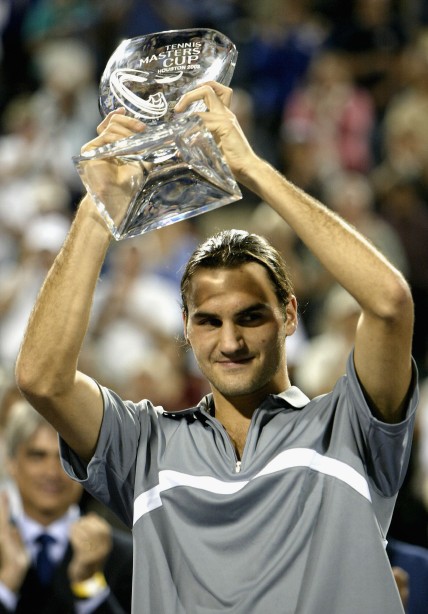
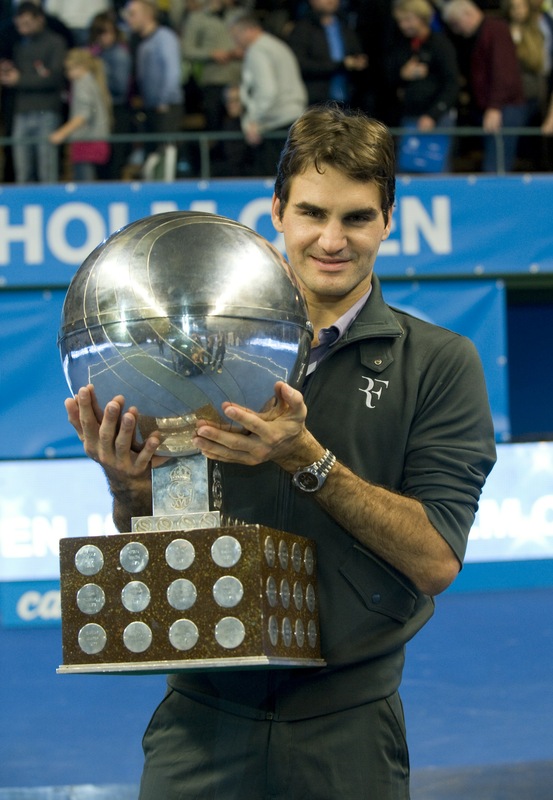
Anyhow, to make this digression relevant: Federer ended up at 3 of 7 (42.85%) on break points against Mayer last night. He totally nailed his average. Actually, average is the word, since this was a pretty routine affair, and one that didn’t stray far from the theme of the week, which was of Federer getting challenged early, before storming home strongly. For his troubles, he got to hang out with the Crown Princess of Sweden, heft the daintiest of trophies, and bask secure in the knowledge that his old pals Bjorkman and Johansson will retain their jobs for another year.

For the record, it was Federer’s 64th Tour level title, meaning that he is now tied with Pete Sampras at 4th on the all time list, behind Connors (109), Lendl (94), and McEnroe (77). The question has been bandied about: Will he pass McEnroe? The answer is no, probably not. For him to get another 14 titles, he would have to start playing more of these little 250 events, at precisely the age when that’s the last thing he should be doing. Not gonna happen.

Here are some random jottings from the week:

  • What the hell is going on with Tomas Berdych? Time was that this kind of slump followed on from actually winning a Grand Slam. I suppose in this era of Federer-Nadal domination, the headcases have to take what they can get.
  • Robin Soderling. I really don’t know what to say.
  • I think Federer looks great in lavender.
  • People profess to see a vague resemblance between Florian Mayer and Fabrice Santoro. I’m not seeing it.
  • I wonder if those net contraptions the ballkids were using will catch on elsewhere?
  • Seriously, that trophy was absurd.

The full match, as well as many others from this tournament, can be downloaded here. As ever, please avoid highlights.

1 Comment

Filed under ATP Tour

If Stockholm Open Quarterfinals, 22 October 2010

Nieminen d. Blake 6/0 6/2
Here is a pressing question. Of these three players, whose career is the most depressing to contemplate:

  • James Blake
  • Lleyton Hewitt
  • Juan Carlos Ferrero

Hmm, I posed the question flippantly by way of introducing Blake’s humiliating loss to one-time bunny Jarkko Nieminen, but now it’s piqued my interest. I’ll go into it further some other time, but for now I’ll admit that the more I think about it, the more I honestly can’t decide. Each player’s tale has a certain Lear-esque quality. Then again, unlike King Lear – who foolishly lived before celebrity endorsements – each of these guys has earned squillions in prize money, and many times that pushing product.

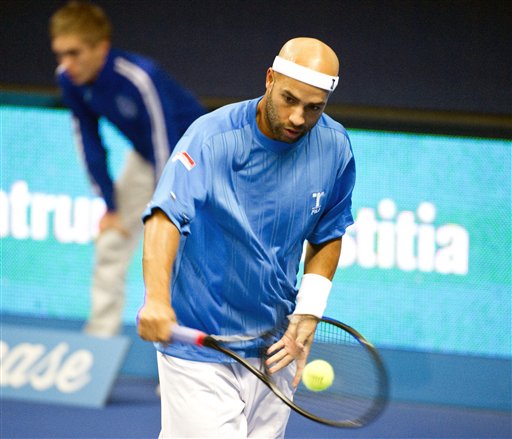
Nevertheless, there is indeed something tragic about the arc of James Blake’s career. I’m not American, so I’m not obliged to find it profoundly so, but still, seeing him thrashed by Jarkko Nieminen at the If Stockholm Open mired my spirit. In their six previous meetings, Blake has never lost. He lost today. He looked lost.

For both men, 2006 was the career year. Nieminen gained his highest ranking of 13, while Blake finished at No.4 after storming to the Masters Cup final. Fittingly, they contested the final of the If Stockholm Open that year, with Blake triumphant. They’ve both since fallen away, although no one would call Nieminen’s decline tragic. Of course, he was never a Grand Slam contender. Looking back, I’m not sure Blake was, either. He has never progressed past the quarterfinals at a Slam. Back when this stat seemed relevant, it was surprising. Now, it feels about right.

Coming into the event this year, it’s clear that neither man has had a stellar time of it. Nieminen is ranked 45, and is 23-23 for the year. This places him exactly 90 spots above James Blake, who at No.135 is only present due to a wildcard. He’s won the event twice, and now it’s only by the grace of Bjorkman and Johansson that he gets to play at all.

As for the match, the Finn played well above his ranking, and Blake displayed his usual poise and restraint. He can still belt a mighty forehand – actually, he can still belt all of them – but his movement is not what it once was. You can tell from the way he kept retreating to the backhand corner, a lazy conceit that Nieminen was merciless in exposing.

Leave a Comment

Filed under ATP Tour