A Picture of Marat

I have a particular picture of Marat Safin, captured when I was roaming the grounds at Melbourne Park one year, during the final round of qualifying. It might have been 2002, or 2003. I’m pretty sure it was 2002.

It was mid afternoon, and it was hot. I’d discovered my limit for watching the Bogomolov Jnrs and Christoph Rochuses toil across the outer, as well as one relentless flag-waving American fan, bellowing facile exhortations at Justin Gimelstob or some other late-career also-ran. The others in attendance – a typically heinous mixture of Dads towing sons and leathery, lank-haired Latin coaching sundries – emphatically declined to get caught up in it. There was zero atmosphere. I took myself off for a stroll.

Wayne Arthurs was serving on a mostly empty Show Court 2, with his paid help torpidly nodding. Whatever Arthurs was doing, they were agreeing with it. Really, what more could anyone possibly bring to that flawless motion? Why was Arthurs even practicing it? Shouldn’t he be working on his returns? I idled there a few minutes, during which time every single delivery curved into precisely the same spot. There is a perfection to the Arthurs serve, but watching it only remains interesting until you’re certain he can do it every time. He can, so I moved on.

Next door is what used to be called Show Court 1, but is now Margaret Court Arena, the inspiration of some genius with a tremendous sense of humour, or none. It was there that I discovered Safin. He was unbuttoned, in several senses of the word. His shirt was off, he was ripped, and he was ripping groundstrokes with tremendous force. He was good at that. He seemed calm.

Looking back, I kind of wish I’d had the wherewithal and prescience to let know him how the rest of the decade would pan out, how the peaks would be few though lofty, and the valleys broad and deep as chasms. It is precisely the kind of metaphor that would have seemed pointless to him. It was January 2002 – I’m sure of it now – and his slump extending back to the Paris Masters of 2000 was still widely blamed on injury. We were two weeks away from the truth. With an entourage supplied by Hugh Heffner from old Playboy Mansion floorstock, Safin would stride to the Australian Open final over the rubble of a broken draw, there to fold tamely and depressingly to Swedish journeyman Thomas Johansson. From that point on, the main thing to know about the giant Russian was just how spectacularly fallible he was.
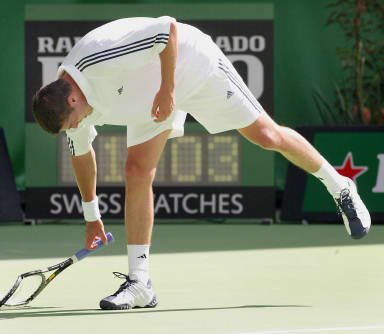
But back to the picture. Safin was pounding the ball relentlessly from both wings, maybe 20 shots in a row between errors. I lurked amongst the shaded upper seats, just another curious fan, and perhaps less interested than the three teenage girls twittering (like birds; not tweeting) off to my left. He was working hard, but not as hard as his hitting partner, whom I didn’t recognise. Suddenly he rushed forward to pounce on a short ball, slamming one of those patented hop-backhands up the line. His opponent reflexed it back, and Safin casually netted the easiest of volleys, the way most pros tend to in practice. Safin, who’d just belted a good match’s worth of prime groundies without hesitation or effort or thought, let out a bellow of purest frustration. It’s not like he’d been working on his volleys, and he’d certainly made no great effort at the one he’d stuffed up.

The girls giggled, nervously. To them he was just a dreamy hunk, made hunkier by fame and dreamier by an accent. Large men with their shirts off were precisely the reason they were at Qualifying in the first place. His roar was only the latest and loudest of dozens they’d heard that day, tiny frustrated punctuations in a hundred aspiring and expiring careers, being played out for bored and smattered applause. (It’s free to attend Qualifying, but for most that’s not enough reason to go.)

But that’s not what Safin’s roar was. Honestly, I don’t know what it was, as tempting as an easy interpretation is. The veritable Sisyphus of modern tennis, he of course invites interpretation. After he’d belted the offending ball into the net with baleful petulance, he stalked off to the side, away from his coaches, towards me. There he stopped, peering blankly, and I had the feeling that the purpose of the roar had been to purge his mind of thought. For some years I looked at it this way, but I no longer do. It was just a moment, just a yell at no one. He missed a volley. The shadow from one of the awnings above the Margaret Court Arena Stadium slashed his sweat-streaked torso, neatly cutting it in two.

Some years later, apropos of nothing much, I thought about this moment, this image, and the idea came to me that Marat Safin and Lleyton Hewitt are two halves of the greatest tennis player that never lived. That’s not a pleasant picture, but my one of Safin brooding vacantly away from his coach is. I sums up something essential about his character, and I still don’t know what. I really wish I’d had a camera.
Leave a Comment

Filed under Players

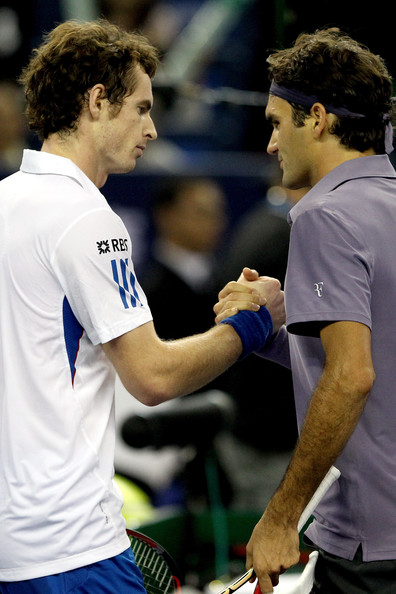
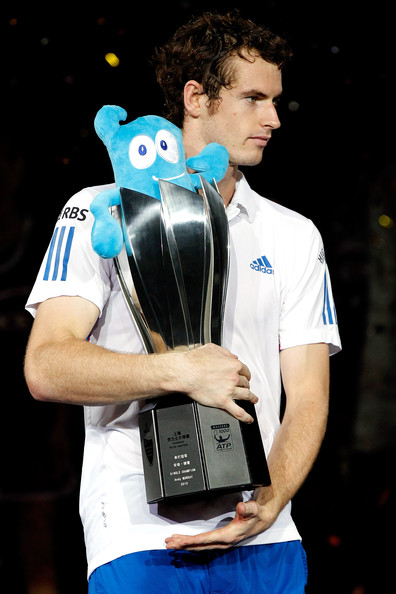
Shanghai Masters 1000 Final, 17 October 2010

Murray d. Federer 6/3 6/2
It is tempting to say that when Roger Federer dropped serve from 40-15 in the opening game of the match the writing was on the wall. Equally, when he failed to convert on two break-back points in the third game, I’d like to report that I adduced how the rest of this final was going to pan out. But I didn’t, of course I didn’t. Narrative is the shape we choose for events we’ve already seen, and (to pretentiously paraphrase Sartre) this night delivered its riches in a jumble.

Anyway, there was another, equally persuasive narrative at work. Namely: form. True, Murray entered the match trailing dismembered opponents in his wake. But then, so had Djokovic the night before, only to discover that obliterating lesser opposition counts for little when you run into the dudes who monogram their sneakers. There was no reason to think Murray would fare any better. Except he did, and as it happened, those two early events did indeed prove indicative of how the match would play out.

Firstly, at no moment would Federer be safe, even on a first serve at 40-0. In fact, especially at 40-0, since Murray missed precisely one return from the ad court all match, and his returns were invariably potent. Even lining up a shoulder-high half-court ball with his forehand, with Murray off the court, Federer was not safe. No points more ably demonstrated this than the last couple of the first set. Both were points Murray had no business winning, yet win them he did, with a pair of improbable forehand passes that brought the house down. “Murr-aculous!” crooned Robbie Koenig.

The other clear thread was Federer’s impotence at the key moments. Six times he failed to convert break points, and only once was it due to a service winner. A large part of hiring Paul Annacone was apparently to inject more aggression into his play. With that in mind, we can imagine how disappointed his new coach must have been when Federer blew one break chance with a lame drop shot into the net, or when he engaged in a 29-stroke rally and never once sent the ball within a metre of either sideline, instead seeking to bamboozle an utterly unflappable Murray. In the end, he invited Murray to go up the line, and so Murray did, smacking a clean winner that was itself not close to any line, or to Federer.

Honestly though, a better Federer would have made it closer, but that’s not a reason to think he would have won it. This was Murray’s match from the get-go. He was clean where Federer was sloppy, desperate where Federer was agitated, and always willing to run. It’s the best I’ve seen Murray play since the Australian quarterfinal, which is high praise for a guy who took out Nadal and Federer back-to-back in Toronto, both of whom favour personalised footwear. The trick for him will be to maintain this kind of form and confidence once the big boys get to London, when the English will suddenly remember they’re British for a week, and the Scot will be installed as unbackable favourite by a rapacious press.

As for Federer, he can hardly be displeased with his week, especially considering it was his first outing since the US Open, and that he posted fine wins over the likes of Isner, Soderling and Djokovic. He’s due to play Stockholm next week, but a strong showing here might well see him pull out of that one, the better to remain fresh for his beloved home tournament in Basel. Beating Djokovic there would really be sweet revenge.

Over-the-top MC moment of the week: “Let’s use our cameras and video cameras to capture this historical and epoch-making moment!”

Full matches from this event can be downloaded here. As ever, please avoid highlights.

Leave a Comment

Filed under ATP Tour

Shanghai Masters 1000 Quarterfinals, 15 October 2010

Well, it was men’s quarterfinal day, and three of the Big Four were in action, as was the man who’d vanquished the fourth the night before.

Djokovic d. Garcia-Lopez 6/2 6/3
It looks on paper like an easy win for Djokovic. It wasn’t, but it was a convincing one, which is far more impressive. The fact is that Djokovic is looking so sharp – so damn sleek – right now that it’s easy to forget his opponent is in career-best form. Garcia-Lopez actually played decently today; flashy at times, but solid, too. Djokovic, however, is enjoying the finest form I’ve ever seen him in, including his run to the Australian Open title a few years ago. He looks dangerous, at all times, and from anywhere on the court.

For his part, GGL has had a standout Asian swing, and should feel tremendous pride in his efforts. In the three weeks since he arrived in Bangkok, his ranking has improved from 53 to about 28. This included the title in Bangkok and an unlikely victory over Nadal there, as well as quarterfinal runs in Tokyo and here. He also supplied the highlight of this match: a backhand winner up the line clocked at 165kph, the fastest recorded ground-stroke of the week. His single-handed backhand is a thing of beauty.

Murray d. Tsonga 6/2 6/2
Not too much to say about this one. Like his compatriot Gasquet yesterday, Tsonga was hardly present. It transpired afterwards that he was carrying an injury to something or other. He also seems to be carrying some extra weight. He certainly seemed puffier in the face than I remember him being. Anyway, Murray was steady and made him work and run. The Frenchman seemed interested in neither.

Monaco d. Melzer 6/7 7/5 6/2
How quickly things can change in tennis.

One day you’re beating Mischa Zverev, and the next you’re overcoming Jurgen Melzer. It just goes to show that anything is possible. Juan Monaco is now into the semifinals of a Masters 1000 for the first time.

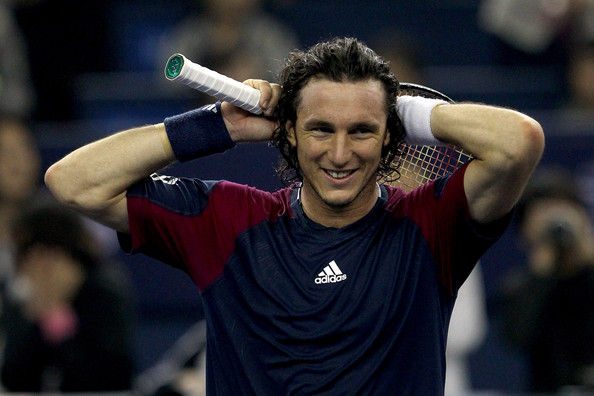
Monaco has this strange facial tick: sometimes when he’s pleased, as when he’s just won an excellent point or something, the sides of his mouth curve upward. Occasionally he’ll even show his teeth. The expression seemed familiar, and some light googling revealed that it was a ‘smile’. Consulting my inner tennis-dictionary reminded me that a ‘smile’ (when deployed during a tennis match) is a gesture intended to convey the sardonic impression that your opponent has only won a point due to sheer luck. It was a familiar gesture in a confusing context. It was clearly some kind of gamesmanship. I hope the ATP looks into it, lest it spreads, and other players begin expressing their satisfaction at winning points with anything beyond fist-pumps and primal roars.

Federer d. Soderling 6/1 6/1
I’m working on an article about the Soderling phenomenon at the moment, in which I argue that his inflated status is largely the result of two victories (you know which ones) whose true significance lies more in the incredible records they ended (or forestalled), rather than being particularly revealing about Soderling’s status within the men’s game. These results have fooled many into viewing Soderling as a legitimate contender at the big events, and as a genuine rival to Federer and Nadal. I have nothing against Soderling, but neither proposition is true.

Tonight’s match did nothing to confound this analysis. Soderling wasn’t playing well, and Federer was. It takes a special kind of focussed ruthlessness to keep your foot on an opponent’s throat in this kind of match, but Federer did precisely that, never veering from his game plan of taking away the Swede’s time and keeping him perpetually off-balance. Soderling is above all a rhythm player, and there is always a danger that he can stroke his way back into form given sufficient balls to hit. Federer gave him nothing.

[Edit] I note the ATP website is calling this one Smackdown in Shanghai. Apt.

Leave a Comment

Filed under ATP Tour

Shanghai Masters 1000, 13 October 2010

Enter the Big Four
The tournament proper got underway today, with the top 8 seeds in action following their first round bye. This included the four best tennis players on the planet.

Nadal d. Wawrinka 6/4 6/4

Steady (though not spectacular) against a tough first-up opponent in Stanislas Warwinka, Nadal’s performance very much highlighted what has seemed apparent to me for the last few weeks: he’s not confident on his backhand. It’s clearly a concern. Time and again he was short from that wing, and Stan would go there to open up the forehand, in much the same way that Monfils didn’t in Tokyo. (Warwinka is clearly a better tennis thinker than Monfils, but that hardly qualifies him as a genius, since he doesn’t read Dostoyevksy). Again unlike Monfils, Wawrinka demonstrated that with sufficient aggression, Nadal can be hit through on a fast hard court. Several times the Spaniard opened up the forehand side, blasted a big off-forehand crosscourt, only for Stan to track it down and hammer it back crosscourt, where the power and audacity of the shot would rock Nadal back on his heels.

But despite all that, Nadal won, and he won by winning the big points, as the scoreline suggests. At the crucial moments, time and again, the Spaniard characteristically lifted, bombing first serves or clever change-ups on the second, hitting out on his forehand. The Swiss, unsurprisingly and inevitably, folded, the depressing destiny of a deterministic world, the world Nadal’s opponents are made to inhabit. That’s what was so astounding about Garcia-Lopez’ win a few weeks back: his momentarily broke through into a different world. Having nothing to lose, he played like it, even once he’d maneuvered into a position to blow it all. Troiki almost got there in Tokyo, but ultimately remained mired here. Nadal’s forehand up the line remains scintillating, and is clearly his form shot of the moment.

Federer d. Isner 6/3 6/4

Speaking of other worlds, Federer’s first match since the US Open saw him drop-shotting and wrong-footing the 6’9 Isner at every opportunity. Somehow, we all predicted we’d be seeing some pretty impressive serving, and when Federer closed out his opening game in 47 seconds, we were proved right. All in all, tight stuff from Federer, especially after a long lay-off, against a rhythm-less opponent. Oh, and he hit another tweener. It wasn’t a winner, but it won him the point. The crowd went predictably bananas.

Leave a Comment

Filed under ATP Tour

Shanghai Masters 1000, 12 October 2010

Roddick d. Kohlschreiber 6/3 2/1

Andy Roddick looked startlingly sharp today, the sharpest I’ve seen him since Miami. Then again, it could be that I haven’t seen him play an early round match since then. Maybe he’s been starting all his tournaments this well. Kohlschrieber is a dangerous customer, although he was clearly operating below his best. At 2/1 in the second, down a set, he defaulted due to illness. Nonetheless, Roddick was actually hitting shots past him consistently in that first set. The technical explanation for this is that he was hitting the ball harder. You see, tennis really is a complicated game.

Tipsarevic d. Golubev 6/3 6/4

When he’s really cranking that backhand, Andrey Golubev looks like he should be in the top 20. He certainly looks like he should be beating Janko Tipsarevic. He lost in straight sets. The Russian, er, Kazakhstani is clearly prone to overhitting, and is basically fodder for any opponent who can get that extra shot back, unless he’s having a lights-out day. Today he wasn’t, and the Serb got back enough stuff.

On a more important note: for the love of all that is holy can the commentators stop reminding us that Tipsarevic reads Dostoyevsky? We get it, he’s a genius. Speaking of commentators . . .

Ljubicic d. Zhang 5/7 6/3 6/4

The stream I watched of the Ivan Ljubicic – Ze Zhang game was apparently being called by Ray Romano. If it wasn’t Ray Romano, it was someone doing a fair imitation, except they’d been hosed down with boring.

The match itself illustrated just how tough the men’s game is. Zhang is ranked 308th, and Ljubicic 17th. Hardly anything seperated them, except experience. In the crucial moments towards the end, it was the Croatian who could maintain a level closer to his ‘real’ ability. That’s something to remember. As good as the pros are in matches, they’re much better in practice.

Indeed, the most ferociously-played tennis match I’ve ever seen was in a practice session between Stefan Koubek and Max Mirnyi, on an outside court at Melbourne Park a few days before the 2001 Australian Open commenced. They were ripping everything (and showing considerable leniency on any ball less than a foot long). I’ve seen those two play any number of professional matches, and it was nothing like this day. It really rammed home just how much the level plummets from the practice court to the match. I suspect that Zhang today was playing something near his practice-level. A quick perusal of his recent results – he regularly bows out in the first round of Challengers – does not refute this.

In a similar vein, Radek Stepanek went down to 455th ranked wildcard Yan Bai. Experience counts for a lot, but it can’t save you every time.

Leave a Comment

Filed under ATP Tour

Ninety Percent Mental

Tokyo Open, Final

Nadal d. Monfils, 6/1 7/5

The thought occurred to me, whilst watching Rafael Nadal wallop Gael Monfils earlier, that maybe we over-analyse why tennis matches are won or lost, or why certain players do the things they do. We concoct elaborate and fantastical psychologies to explain why a break point was played this way and not that. A graphic of second serve placement gets flashed up on the screen, and we immediately adduce an overarching strategy, as though each dot was a gun emplacement at Austerlitz.

Perhaps it’s all much simpler. Perhaps some tennis players just aren’t very bright. When you think about it, underlying all of our analysis is the tacit assumption that all players are basically moderately intelligent, capable of not only grasping a winning strategy, but of applying it and sticking to it. Perhaps we assume too much.

Every time Nadal smoked another forehand winner up the line (his fearsome shot du jour, or semaine), I’d holler through my screen at the improbably lithe French dude up the other end, “Go to his backhand!” Every time an emphysemic Nadal backhand sputtered and croaked its way to the service line, I’d roar it louder. “His backhand! For the Love of God, go to his backhand!” Using my tremendous physic powers, I projected ten-foot neon letters onto the back hoarding: “Stay away from Nadal’s forehand!” The writing was on the wall, figuratively and telepathically. Sadly, having little French, the writing was in English.

Now, it’s possible to overwhelm Nadal’s forehand on a hardcourt by hitting through it, rushing it by going deep, flat and very hard. Viktor Troicki showed us some of this in the semifinal. But it can’t be done from where Monfils was lurking, deep at the back of the court near the writing on the wall. (Perhaps he was trying to lose himself in the crowd, though I can’t imagine the crowd that Monfils might successfully hide in.) Conceivably, this was a strategy designed to negate Nadal’s vicious topspin, since the ball was generally on its way down by the time it got to the Frenchman. This seemed unlikely for several reasons:

  1. Monfils is tall enough to get over the spin, especially with his double-fisted backhand;
  2. The Tokyo court wasn’t bouncing all that high;
  3. This would imply that Monfils was employing any strategy at all.

Perhaps I’m being unfair, and Monfils was drawing inspiration from Nadal’s improbable loss to Guillermo Garcia-Lopez in Bangkok last week. Perhaps the ‘strategy’ – and the term is being used so loosely it may well be dislocated – was to drop the first set quickly, then hope the Spaniard blew 24 break points in the second. It would be like the Rumble in Jungle, and which Ali allowed Foreman to grow exhausted from punching him so much.

It is sometimes remarked that being Monfils’ coach would be the world’s most frustrating job. That may be true, but again, perhaps we’re assuming too much. Maybe it was Roger Rasheed’s masterplan to feed balls up the middle of the court, at three quarter pace, all day. After all, playing within himself and inviting attack keeps Monfils in the top 20. Paradoxically, desperate retrieving from all parts of the court seems to be his percentage play. It’s gained him a cult following and sees him feature on countless highlight reels. But for every recovery from a seemingly hopeless position, there are the uncounted errors from actually hopeless positions. And the thing about percentages is that while they’ll wear down the hoi polloi, they won’t impress the big boys. Nadal’s forehand is to percentages what a howitzer is to passive smoking.

To beat Nadal on clay you need a miracle. To beat him on a hardcourt, however, you need a plan, with the skill and willingness to execute it perfectly. And you also need the intelligence to adapt when it all inevitably goes south. It’s somewhere in that chain of requirements that Monfils gets lost. Is that all too complicated? I’ll make it simple: Go to his backhand. It’s not rocket surgery.

Commentary gem of the week, courtesy of Jason Goodall: “It’s deja vu all over again!” Pure Yogi Berra.

Leave a Comment

Filed under ATP Tour

Tokyo and Beijing Quarterfinals, 8 October 2010

Monfils d. Roddick 7/6 4/6 7/6

Roleplay time!

You’re a hardcore American tennis fan who suffered severe head trauma (boating accident) and was placed into an induced coma circa October 2003. Andy Roddick was perhaps the most exciting and dynamic tennis player in the world, having dominated the US Summer. You found his US Open win to be an inspiring, patriotic triumph.

It’s now seven years later and you just woke up yesterday (hooray!). You’ve switched on the TV only to see Roddick – what ever happened to that cool visor – lose to some oddball French beanpole named Gael. You did not hear it mentioned in the telecast, but you’re intensely curious to find out what debilitating injury Andy Roddick has sustained, compelling him to push all his groundstrokes at half speed? Did he too suffer severe head trauma? And who was the lanky giant that beat him, and why was he standing 14 feet behind the baseline? What the hell is going on with tennis?

How many more Slams did Roddick win? He was unstoppable when you went under. What’s that, none? Wait, Federer? The Wimbledon guy? He did what now?!

You’re on a horse.

Ljubicic d. Murray 6/3 6/2

What’s not to love about Ivan Ljubicic? He seems like a cool guy. I have to admit, I’m a fan, and am ready and willing to labour the point with anyone that feels his game is one-dimensionally serve-centred. Although I concede that 2006 (along with 2002) saw the weakest top five of the last decade, I was still pleased to see my favourite Croat in amongst it. He was also part of the best match no one saw of 2009, which was his 2nd round loss to Jo-Wilfried Tsonga at the Australian Open (check it out if you can find it).

Anyhow, I appreciated his run to the Indian Wells title enormously, and I’m pretty impressed that he overcame Andy Murray so convincingly in Beijing today. What does this mean for Murray? The population of Planet Earth is united in having no idea.

Leave a Comment

Filed under ATP Tour

Great Matches You’ve Probably Never Heard Of #1

Los Angeles Final 1999

Sampras d. Agassi, 7/6 7/6

Andre Agassi devotes only a few lines to this match in Open, but this is how he chose to remember it: ‘I fly to Los Angeles and play well. I meet Pete in the final. I lose 7-6 7-6, and don’t care. Running off the court, I’m happiest guy in the world.’

Bollocks.

He cared, alright. I’ve hardly seen Agassi more edgy and committed for a match. He seems to spend an inordinate amount of time hollering and roaring into his shots, lashing himself himself over rare errors and hustling gallantly on a pretty hot day. He cared plenty. These two can’t step onto a tennis court together and not care. If you want proof – squirmingly discomforting proof – check out the Hit for Haiti charity event from March of this year.

Anyway, a bit of context. This was the tournament at which Pete retrieved his No.1 ranking from Agassi (another thing the latter proclaimed indifference towards). For Sampras, LA was the third of four consecutive tournament wins going back to Queens and including his record-equalling 12th Slam at Wimbledon. He would go on to win the Cincinnati Masters (defeating Agassi and Rafter en route), before withdrawing with a hip injury in the quarterfinals at Indianapolis, ending a 24-match streak. (At 28 years of age, with 12 Grand Slams under his belt, what the hell was Sampras doing playing LA and Indianapolis? Can you imagine Federer doing that? No, and with good reason: Sampras was forced to withdraw from the US Open with a back strain, aggravating an existing issue that had plagued him during the clay court swing.)

Agassi, for his part, had recently won the French Open, had reached the Wimbledon final, and was to go on and claim his second US Open the following month. However you cut it, both these dudes were in some form, and both characteristically inspired the other to stratospheric heights. Without exaggeration, I am convinced the first set of this match is the highest sustained standard I saw between them. As Frew McMillan remarks in the Eurosport coverage, it’s the ferocity of the play that is so startling. The pace is furious. The 2001 US Open quarterfinal is amazing – an all-time classic – but I think the quality here is higher.

The arc of the match is interesting, as the desperate winners, saves and breaks of the first set give way to the mounting tension of solid holds in the second. As ever, it’s Sampras that is prepared to go biggest when it counts. On a court as slick as this one, his serve is brutal, which is all the edge he needs in the tiebreaks. Stay tuned for the match point: it’s a frantic all-court gem.

Other moments worth mentioning:

  • Sampras’ sublime play to break in the second game, a beautiful example of the sudden acceleration he was capable of. Andre always professed himself baffled by Pete’s lack of need for inspiration, but if these surges aren’t examples of inspiration, then what is?
  • The game at 4/2, when Agassi finally breaks back. This game has it all, and is an exquisite miniature of what made the Sampras – Agassi rivalry great.
  • After this game, as Agassi sprints to his chair – he really didn’t care? – I note Brooke Shields cheering from his box. According to Agassi, he was off on his first date with Steffi Graf after this match.
  • There are countless barnstorming shots, but none better than Sampras’ lunging stab drop volley at 4/4 15-15 in the first set. In the reverse angle replay, you can see the thing break sideways as it hits the court, and just die.

The 1999 LA final was as representative as any match that these two played. It demonstrates that at his best, Sampras was still the man to beat. As he would do at in the last match of the 1999 season, when he overwhelmed Agassi in the Masters Cup final, Pistol Pete proved that when the big moments came around, he could go to a place beyond even his great rival’s reach. That’s what inspiration is.

The full match is available on Youtube. Part One can be found here.

Leave a Comment

Filed under Great Matches

Bangkok and Kuala Lumpur, 1 October 2010

There are few things our society loves more than seeing an alleged expert revealed as a pretentious charlatan, for their so-called expertise to be revealed as mere sophisticated chicanery. One of the preferred stings – beloved of tabloid news programs – is to submit a bunch of wine connoisseurs to a double-blind test, and ask them to grade the wines by quality and price. Invariably they get it wrong, and pick a $12 dollar as premium, and a $100 bottle as table swill. The subtle subtext is that wine-appreciation is a load of crap. Anyway, real men drink beer.

With that in mind, how many experts picked these results in Bangkok and Kuala Lumpur:

  • (8) Andrey Golubev d. (1) Robin Soderling 6/3 6/2
  • Guillermo Garcia-Lopez d. (4) Ernests Gulbis 7/6 4/6 6/3
  • Jarkko Nieminen d. (3) Jurgen Melzer 6/3 7/6

Personally, I’m 0/3 on those. Other results were less startling, though the matches were excellent:

  • (5) David Ferrer d. (3) Tomas Berdych 4/6 7/5 6/4
  • (4) Mikhail Youzhny d. (6) Marcos Baghdatis 6/7 7/5 6/1

Both were crackers, and both timely reminders that a tennis tournament doesn’t have to be meaningful to be worthwhile, it just has to feature good tennis. Commentators who endlessly bemoan the ‘pointlessness’ of the season after the US Open should perhaps spend less time pondering the philosophical ramifications of the ATP tour. There are plenty of good players in the Asian swing, and they don’t seem to be trying less hard because Kuala Lumpur isn’t leading up to a Slam.

Having said that, you do have to wonder why Rafael Nadal is in Bangkok. I’m guessing he doesn’t need the money, and an extra week’s tune-up for the Shanghai Masters seems like overkill. But then, this is the part of the season when he’s usually at his worst. He definitely wants to remedy what has clearly grown to become a structural issue with his season. Having won his first US Open a few weeks ago, I think it’s admirable he’s here. Back in 2004, Federer also played Bangkok after winning his first US Open, and won it (bagelling Roddick in the final!). We should not discount the fact that Nadal’s presence is an enormous benefit for these tournaments, and that the Spaniard takes his duties as No.1 as seriously as Federer did.

Anyhow, Rafa  looked sharp in overcoming Kazakhstan’s new Davis Cup hero Mikhail Kukushkin 6/3 6/2. Nadal’s important stats:

  • Aces: 7
  • Double Faults: 0
  • 1st Serve %: 79%
  • Winning 1st Serve: 91%
  • Breakpoints Saved: 0/0

The serve that swept him to the title in New York is here to stay. Does it feel to anyone else like the last piece of the puzzle has fallen into place? Expert opinion says yes.

Leave a Comment

Filed under ATP Tour

Kuala Lumpur, 29 September 2010

Finally found a stream, only to discover Baghdatis serving for the match at 5/4 in the second. Giraldo is crushing every second serve that comes his way. And now he’s broken back. 5/5. Is this the same Cypriot that served Nadal off the court in Cincinnati?

The Bag-man eventually serves it out 7/5. Not convincing.

Giraldo has a weird service motion, very fast, almost fluttery. It’s a ‘clay-court serve’, in much the same way that an ugly person has a ‘radio face’.

Leave a Comment

Filed under ATP Tour